Purpleheart Wood: Properties, Uses & Working Tips
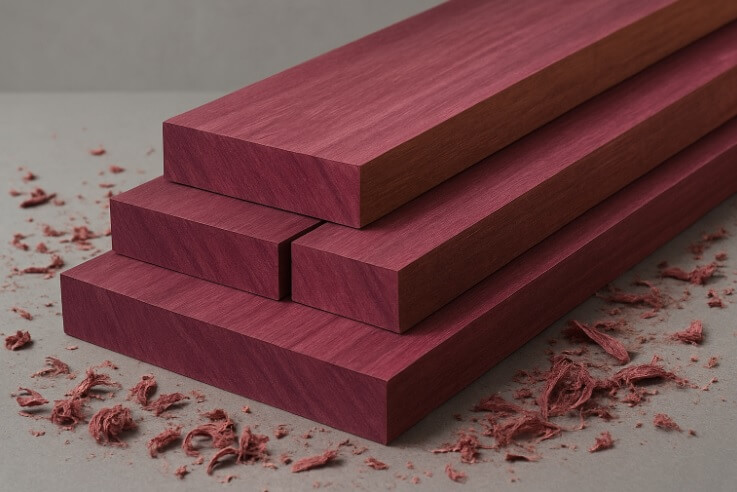
Purpleheart wood is a dense tropical hardwood from trees in the Peltogyne genus, best known for developing a naturally vivid purple heartwood color. Native to Central and South America, it combines distinctive appearance with high hardness, strength, and natural durability. Those same qualities also make it heavier and more demanding to machine than many familiar domestic hardwoods.
Its color is another important consideration. Freshly cut purpleheart may initially look muted or brownish-purple before developing a stronger purple tone with exposure, then gradually darkening again with age and ultraviolet light. This guide explains its properties, color behavior, uses, workability, finishing, safety, and what to look for when buying purpleheart lumber.
What Is Purpleheart Wood?
Purpleheart is the commercial name used for a group of tropical hardwood species rather than one single tree species. That distinction matters because color, density, strength, and other physical properties can vary among species, individual trees, and boards sold under the same commercial name.
Purpleheart Tree and Botanical Origin
Purpleheart comes from trees in the Peltogyne genus, part of the legume family Fabaceae. The commercial name may cover several related Peltogyne species that produce heartwood with the characteristic purple coloration. The wood is also sold under regional or trade names such as amaranth, roxinho, and violeta.
These trees can reach substantial dimensions, supplying lumber suitable for furniture, flooring, construction, turning, decorative accents, and other applications where strength and appearance are both important.
Where Purpleheart Grows
The combined natural range of Peltogyne species extends through parts of Central and South America, from southern Mexico into tropical South America, including important producing regions in Brazil and the Guianas. Commercial lumber can therefore come from different species and growing regions rather than from one uniform source.
Purpleheart Wood Properties at a Glance
Purpleheart is notable not only for its color but also for unusually high density and mechanical strength. The values below are representative reference figures commonly published for commercial purpleheart; they should not be interpreted as exact specifications for every Peltogyne species or individual board.
| Property | Representative Reference Value |
|---|---|
| Scientific name | Peltogyne spp. |
| Native range | Central and South America |
| Average dried weight | About 56 lb/ft³ (900 kg/m³) |
| Specific gravity | About 0.76 basic / 0.90 at 12% moisture content |
| Janka hardness | About 2,520 lbf (11,200 N) |
| Modulus of rupture | About 22,000 psi (152 MPa) |
| Modulus of elasticity | About 2.94 million psi (20.3 GPa) |
| Crushing strength | About 12,140 psi (83.7 MPa) |
| Radial shrinkage | About 3.8% |
| Tangential shrinkage | About 6.4% |
| Natural durability | Very durable against decay; termite resistance has been documented, while marine-borer resistance is poor |
| Typical grain | Usually straight, but may be wavy, irregular, or locally interlocked |
| Common uses | Furniture, flooring, inlays, turning, boatbuilding, heavy construction, and specialty woodworking |
Color, Grain, and Appearance
Color is the feature that makes purpleheart instantly recognizable, but its appearance is more dynamic than the name suggests. The tone changes after cutting and continues to evolve as the exposed or finished wood reacts to air, light, and time.
Why Is Purpleheart Wood Purple?
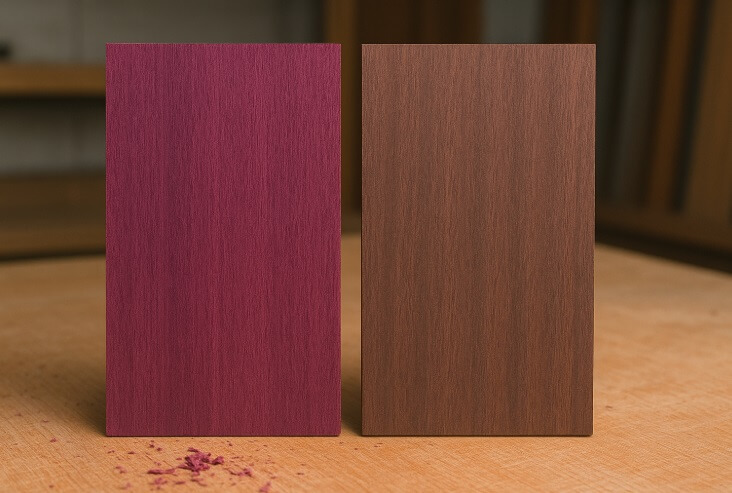
The purple color occurs naturally in the heartwood; it is not normally the result of stain or dye. Freshly cut heartwood can initially appear dull grayish-purple, brownish, or purplish brown. After exposure to air, it commonly develops the richer eggplant-purple color for which the wood is famous.
This means a newly milled surface may not immediately display the same intense purple seen in a finished sample or product photograph. Color also varies from board to board and among the different species sold commercially as purpleheart.
Why Does Purpleheart Turn Brown?
After reaching a stronger purple stage, exposure to light and normal aging gradually pushes the color toward deeper brownish-purple tones. With enough time and ultraviolet exposure, some pieces may appear predominantly dark brown with a purple cast.
This natural color change should be considered before choosing purpleheart for a project where retaining the brightest possible purple is a primary design goal. A suitable finish and reduced UV exposure can slow the change, but they cannot permanently freeze the wood at one stage of its color development.
Grain and Texture
Purpleheart most often has straight grain, although wavy, irregular, or locally interlocked grain can occur. Texture is generally medium, and finished surfaces can show good natural luster. Figured or changing grain can make a board more visually interesting, but reversing grain may also increase the risk of tear-out during planing.
Hardness, Density, Strength, and Stability
Purpleheart is often described simply as “very hard,” but hardness, weight, strength, and dimensional behavior describe different characteristics. Looking at them separately gives a more accurate picture of how the wood behaves in a finished project and in the shop.
Purpleheart Janka Hardness
A commonly cited Janka hardness value for purpleheart is about 2,520 lbf. The Janka test measures resistance to indentation or denting rather than abrasion itself, so the number is most useful for understanding how resistant the surface is to localized impact and pressure.
For context, that reference value is substantially higher than those commonly published for black walnut, white oak, and hard maple. Purpleheart's density and broader mechanical properties also help explain its suitability for demanding applications, but high Janka hardness alone should not be treated as a complete measure of wear performance.
| Wood | Approximate Janka Hardness |
|---|---|
| Purpleheart | 2,520 lbf |
| Hard maple | 1,450 lbf |
| White oak | 1,360 lbf |
| Black walnut | 1,010 lbf |
Density and Weight
Purpleheart is also heavy. A representative average dried weight is about 56 lb/ft³, or roughly 900 kg/m³. USDA data for the broader Peltogyne group show a wider range among species and samples, so one published density should be treated as a useful reference rather than a universal figure.
This high density contributes to the wood's substantial feel and mechanical performance, but it also means large furniture components, thick slabs, and flooring are heavier to transport, handle, and machine than comparable pieces made from many common domestic hardwoods.
Strength and Dimensional Stability
Purpleheart combines high bending and compression strength with substantial density. Those characteristics explain why it has been used not only for decorative woodworking but also for demanding applications such as shipbuilding and heavy construction.
Shrinkage is moderate relative to its density, but good stock preparation still matters. Lumber should be properly dried and allowed to acclimate to shop conditions before final milling, particularly for furniture and joinery where seasonal movement can affect fit.
Rot Resistance and Durability
Hardness describes resistance to indentation, while natural durability describes resistance to biological deterioration. Purpleheart performs strongly in both areas, but keeping those properties separate avoids overstating what any one test or characteristic can tell us.
Indoor Durability
Indoors, biological decay is usually less important than it is outdoors, provided the wood remains dry. Purpleheart's dense heartwood is nevertheless naturally durable, making it suitable for long-lived furniture, cabinetry, flooring, and architectural work where a stable, robust material is desirable.
Its mechanical hardness and resistance to denting are separate advantages for high-use interior applications, but they should not be confused with its resistance to fungi or insects.
Outdoor Use
Purpleheart heartwood is generally rated as very durable against decay fungi. Research has also documented resistance to dry-wood termites in some material, although performance can vary among species and growing regions. That is more precise than treating the entire commercial group as universally resistant to “many insects.”
It can therefore be used outdoors when the design, drainage, joinery, and maintenance are appropriate. One important limitation is marine exposure: purpleheart is not considered highly resistant to marine borers. Outdoor sunlight will also accelerate the loss of the brightest purple coloration even when the wood remains structurally sound.
Working With Purpleheart Wood
Purpleheart can produce excellent finished surfaces, but its density places greater demands on tools and technique. Sharp cutters, controlled machining, and attention to heat buildup are more important than relying on an arbitrary rule such as always feeding the stock unusually slowly.
Sawing and Milling
Sharp, durable cutting edges are valuable when processing purpleheart because the dense wood can dull tooling. Heat is another concern. Dull cutters or excessive cutter speed can generate enough heat to encourage gummy resin to exude, potentially coating cutting surfaces and making further machining more difficult.
Planing and Routing
Straight-grained stock can machine cleanly, but irregular, reversing, or interlocked grain can tear out during planing. Sharp knives, light cuts, and careful attention to grain direction help reduce the problem. Similar care is useful when routing profiles or edges, especially where grain direction changes across the workpiece.
Drilling and Fastening
The wood's density increases drilling resistance and makes accurate pilot holes worthwhile, particularly near board ends or when installing larger screws. Sharp bits and clean chip removal reduce friction, heat buildup, and the chance of forcing a fastener into dense stock.
Sanding
Sanding should remove machining marks without overheating the surface. A normal progressive grit sequence is more effective than trying to remove deep scratches with very fine paper, while fresh abrasives cut more cleanly and generate less unnecessary heat.
Gluing
Purpleheart generally glues well when mating surfaces are freshly prepared, clean, flat, and properly fitted. Standard sound joinery practices—good surface preparation, appropriate adhesive coverage, and sufficient clamping pressure—are more useful than compensating with excessive glue or extreme clamping force.
| Operation | Useful Shop Setup | Why It Helps |
|---|---|---|
| Sawing | Sharp carbide-tipped blade | Reduces friction, burning, and premature tool wear |
| Planing | Sharp knives and light passes | Helps control tear-out in reversing grain |
| Routing | Sharp bit and controlled passes | Limits heat buildup and improves edge quality |
| Drilling | Sharp bit and pilot holes where appropriate | Reduces friction and makes fastening dense stock easier |
| Sanding | Fresh abrasives and effective dust collection | Improves scratch removal while limiting heat and dust exposure |
| Gluing | Fresh, clean, well-fitting mating surfaces | Supports reliable adhesive bonding |
How to Finish Purpleheart and Preserve Its Color
Finishing purpleheart involves two related goals: protecting the surface and managing how its color changes over time. No finish can permanently lock in the brightest purple stage, so the most useful finishing strategy is one that balances appearance, protection, and realistic expectations.
Best Finishes for Purpleheart
Clear finishes are commonly chosen because they allow the natural heartwood color to remain the visual focus. Oil-based products can deepen or warm the tone, while clear film finishes can provide greater surface protection. Because different products can shift the appearance in different ways, testing the full finishing schedule on scrap from the same board is worthwhile.
Purpleheart normally does not need stain to create its signature color. Staining can obscure the natural purple that makes the species distinctive, although a designer may intentionally alter the tone for a particular project.
How to Slow UV Color Change
A finish formulated with ultraviolet inhibitors can help slow color change, especially when the finished piece is also protected from prolonged direct sunlight. The purpose is to extend the more vivid stage rather than promise permanent color preservation.
For indoor furniture and decorative work, placement can matter almost as much as finish choice. Keeping a piece away from strong direct window light can reduce UV exposure and help the purple tone remain visible longer.
Finishing Mistakes That Can Speed Color Change
Leaving a finished piece in strong direct sunlight is one of the clearest ways to accelerate color change. Another mistake is assuming that any clear coat will automatically provide meaningful UV protection; products vary widely in that respect.
If preserving a cooler, brighter purple is the goal, it is also worth testing finishes that noticeably amber or warm the wood before applying them to an entire project. Finally, excessive machining heat should be avoided for workability reasons rather than used as a shortcut for manipulating color. Heat can create resin and tooling problems without providing predictable long-term color control.
Purpleheart Wood Uses
Purpleheart works best where its unusual appearance or demanding physical properties provide a real benefit. Some applications emphasize its color, while others rely more heavily on strength, density, natural durability, or resistance to denting.
Furniture and Cabinetry
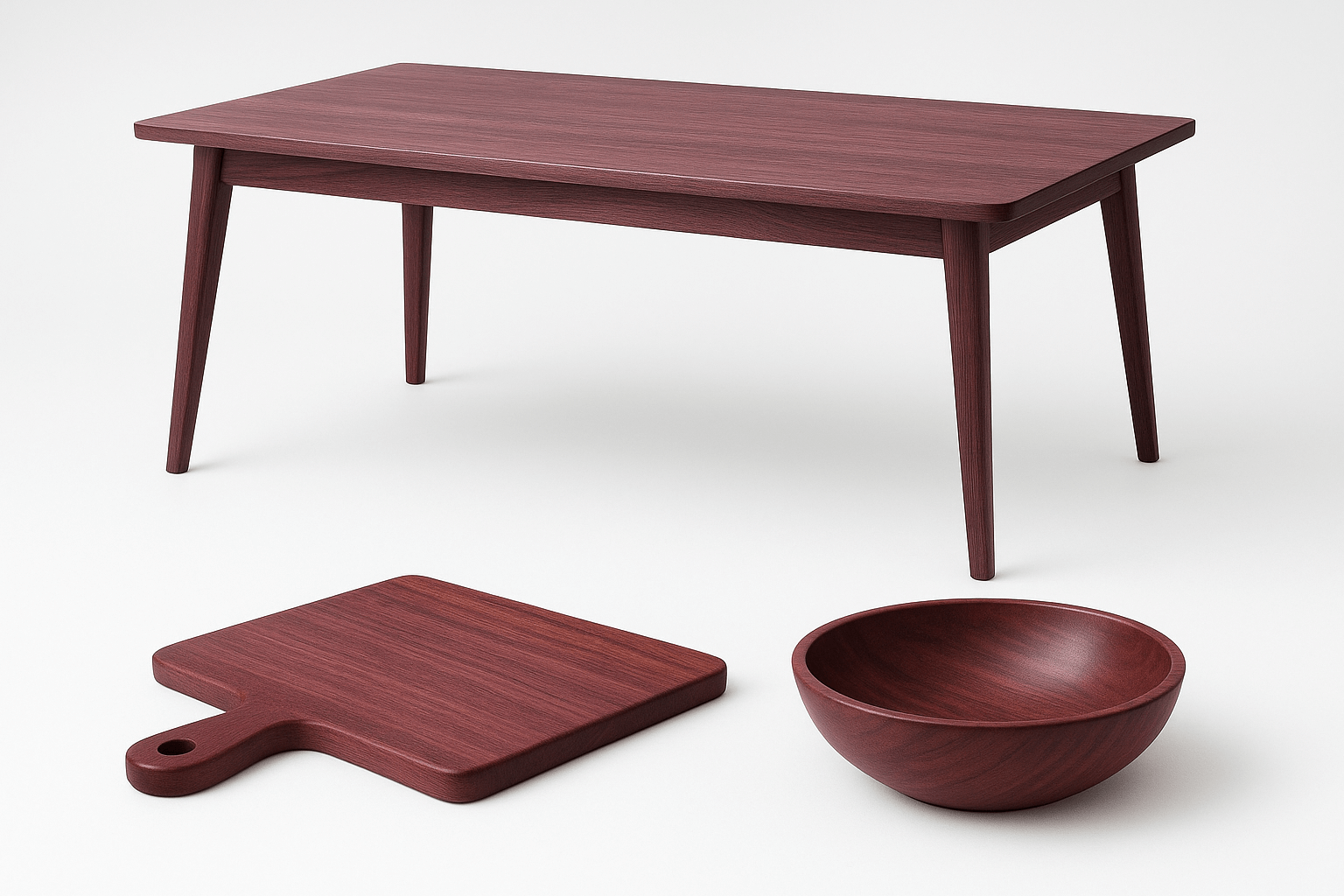
Furniture makers use purpleheart for tabletops, drawer fronts, trim, cabinet details, and other areas where its color can act as a focal point. Large surfaces can be visually intense and physically heavy, so the wood is also frequently paired with lighter or more neutral species.
Flooring and High-Wear Applications
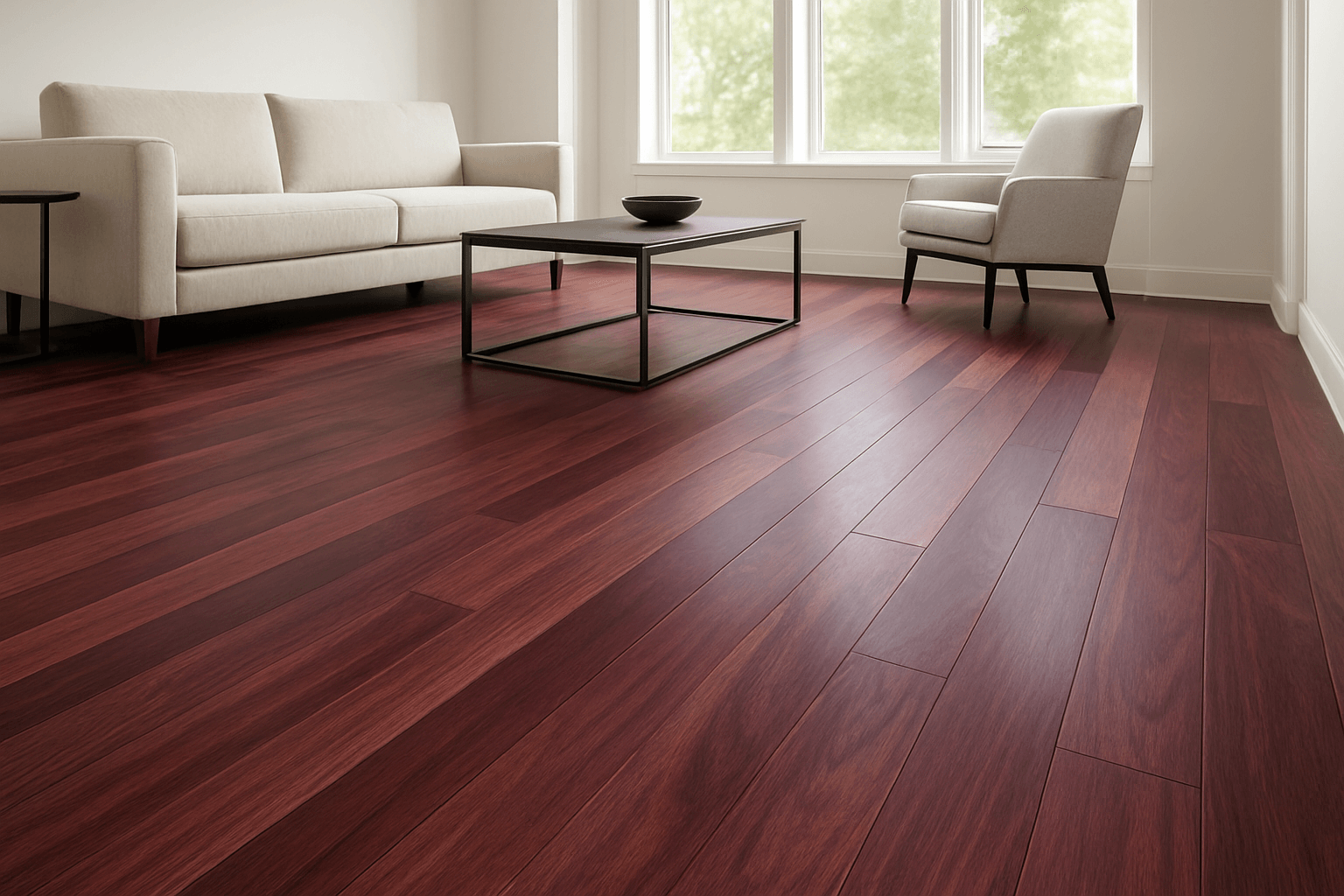
Purpleheart's high hardness, density, and strength make it suitable for flooring and other high-use surfaces. Purpleheart hardwood flooring is much less common than oak or maple because of cost, weight, availability, and appearance, but it can provide a durable specialty floor when properly installed and maintained.
Inlays and Decorative Accents
Inlays, edging, marquetry, contrasting strips, boxes, and other decorative details are especially natural uses because relatively small quantities can provide strong visual contrast without overwhelming an entire piece.
Turning and Small Projects
Purpleheart is commonly used for bowls, handles, pens, cue components, knife scales, small boxes, and other turned or specialty objects. Its density allows crisp details when tools are sharp, while the color gives small projects immediate visual identity.
Boatbuilding and Heavy Construction
The wood's strength and natural durability have also supported utilitarian uses including boatbuilding, shipbuilding, structural work, and heavy construction. These applications demonstrate that purpleheart is more than a decorative novelty.
Musical Instruments
Purpleheart may also appear in selected musical-instrument components and decorative instrument work. In these applications it can be chosen for a combination of density, stiffness, wear characteristics, and appearance rather than color alone.
Purpleheart Wood Safety and Toxicity
Purpleheart can be worked safely with appropriate woodworking controls, but its dust should not be treated as harmless. It is useful to separate reactions reported specifically for purpleheart from the broader occupational hazards associated with repeatedly inhaling airborne wood dust.
Dust and Skin Irritation
Purpleheart dust has been associated with eye and skin irritation, and sensitization has also been reported. Individual reactions vary, so a woodworker who develops persistent skin, eye, or respiratory symptoms should stop exposure and seek appropriate medical advice rather than assuming the reaction is normal.
There is also a broader issue that applies beyond purpleheart itself: long-term occupational exposure to airborne wood dust has been associated with serious respiratory effects and cancer. That does not mean purpleheart specifically has been proven to “cause cancer”; the recognized risk concerns repeated occupational exposure to wood dust and reinforces the need for effective dust control.
Shop Safety
Effective dust extraction, eye protection, and suitable respiratory protection are sensible when sawing, routing, drilling, or sanding purpleheart. Cleaning accumulated dust rather than allowing it to become airborne again also reduces repeated exposure. These practices are appropriate for hardwood machining generally and become increasingly important during frequent or prolonged shop work.
Price, Availability, and How to Choose Purpleheart Lumber
Purpleheart is an imported specialty hardwood in the United States, so cost depends heavily on thickness, grade, quantity, milling, dimensions, and supplier. Availability is generally good through specialty hardwood dealers, but the effective price can change significantly depending on whether you need a few board feet for a small project or commercial quantities.
How Much Does Purpleheart Cost?
As of 2026, small-quantity U.S. retail listings for 4/4 Select & Better purpleheart are commonly around $14 to $15 per board foot. Thicker 8/4 stock can be around $16 per board foot at retail. Prices can fall noticeably on larger orders: suppliers offering 100 or more board feet may quote 4/4 material around $11 per board foot or lower, depending on volume.
These figures are a market snapshot rather than a permanent price guide. Surfacing, hand selection, unusual widths, long boards, shipping, and custom milling can raise the delivered cost substantially, while wholesale or high-volume purchasing can reduce the per-board-foot price.
How to Select Good Boards
Good stock selection is especially important with purpleheart because both grain and color can vary. The best board is not necessarily the darkest board in the pile; it is the one whose dimensions, grain, condition, and eventual appearance suit the project.
- Check boards for twist, bow, checking, and machining damage.
- Choose grain appropriate for the project, especially for large visible surfaces.
- Compare several boards when color consistency matters.
- Remember that freshly surfaced color may change after exposure, so do not judge the final appearance only from a newly cut face.
- Buy dimensions that minimize unnecessary removal of expensive, dense material.
- For multi-board projects, selecting closely matched stock from the same shipment can improve visual consistency.
Is Purpleheart Wood Sustainable?
Sustainability cannot be answered accurately with one blanket statement because commercial purpleheart represents multiple Peltogyne species. Responsible purchasing therefore depends more on species-level information, origin, and traceability than on the commercial name alone.
Peltogyne Species and Conservation Status
Purpleheart as a commercial group is not currently listed in the CITES Appendices, but that should not be interpreted as proof that every Peltogyne species has the same conservation status or harvest pressure. The genus contains multiple species with different geographic ranges, and retail lumber is not always identified to species level.
For that reason, broad statements such as “purpleheart is sustainable” or “purpleheart is endangered” are both too simplistic without knowing which species and supply chain are involved.
What to Look for When Buying
When sourcing purpleheart, favor suppliers that can provide useful information about species, country or region of origin, and supply chain. Credible third-party forest certification can add another layer of assurance when available. Clear traceability is more meaningful than a vague marketing claim that an imported tropical hardwood is automatically sustainable.
Purpleheart Wood Pros and Cons
Purpleheart combines exceptional visual character with serious mechanical performance, but those advantages come with practical tradeoffs. A quick comparison helps determine whether it is a sensible choice for a particular project.
| Pros | Cons |
|---|---|
| Naturally distinctive purple color | Color darkens and browns with age and UV exposure |
| Very high Janka hardness | Harder on cutting tools than many domestic hardwoods |
| High strength and density | Heavy to handle in large pieces |
| Very good natural decay resistance | Heat during machining can cause gummy resin problems |
| Suitable for demanding and decorative applications | Irregular grain can tear out during planing |
| Available in lumber and specialty project stock | Imported material generally costs more than common domestic hardwoods |
Frequently Asked Questions About Purpleheart Wood
These short answers address common questions that arise when comparing purpleheart with other hardwoods or deciding whether it is suitable for a particular woodworking project.
Is Purpleheart a Real Natural Purple Wood?
Yes. Purpleheart develops its purple heartwood color naturally without requiring purple stain or dye. The precise shade varies among boards and changes as the wood is exposed to air, light, and age.
Does Purpleheart Stay Purple?
Not permanently in exactly the same shade. The vivid stage gradually becomes darker with age and UV exposure. UV-inhibiting finishes and reduced direct sunlight can slow that change but cannot stop it indefinitely.
Is Purpleheart Harder Than Oak?
Yes. A commonly cited Janka value for purpleheart is about 2,520 lbf, compared with about 1,360 lbf for white oak. Values vary among individual pieces and species, but purpleheart is generally much harder in terms of resistance to indentation.
Is Purpleheart Good for Cutting Boards?
Purpleheart can be used in cutting boards and is sometimes chosen as an accent wood, but “very hard” does not automatically mean “ideal.” Its high hardness can be tougher on knife edges than some traditional cutting-board woods. Use clean, sound stock, avoid questionable finishes on working surfaces, and choose a food-contact-appropriate finishing system.
Can Purpleheart Be Used Outdoors?
Yes. Its heartwood has strong natural decay resistance and can be used outdoors when the project is properly designed and maintained. Direct outdoor exposure will, however, accelerate the loss of the brightest purple color.
Is Purpleheart Difficult to Work With?
It is more demanding than many common domestic hardwoods because it is dense, can dull cutters, may tear out where grain reverses, and can exude gummy resin when excessive machining heat develops. Sharp tools and controlled cutting make the wood considerably easier to manage.
Explore More About Wood: