Mango Wood: Properties, Pros, Cons & Oak Comparison
Mango wood is the lumber of Mangifera indica, the same tropical hardwood tree cultivated widely for mango fruit. For indoor furniture, it offers a useful balance of strength, visual character, and workability: its average dried weight is about 42.1 lb/ft³, and its Janka hardness is about 1,070 lbf. Its main limitation for furniture is not strength, but its relatively low natural resistance to decay—untreated mango ranges from moderately durable to perishable and can be vulnerable to fungal and insect attack when repeatedly exposed to moisture.
This guide explains what mango wood is, why it is a hardwood even though it is softer than common U.S. red and white oak, its color and grain, properties, durability, furniture performance, pros and cons, U.S. availability, sustainability, care, and the differences between mango wood and oak. You can also explore the Wood Database to compare mango with other hardwood species.
What Is Mango Wood?
Mango wood comes from the same species that produces edible mango fruit and is also harvested for lumber. As a woodworking material, it is a genuine hardwood used for furniture, decorative work, veneer, turning, and other indoor applications.
Is Mango Wood a Hardwood?
Yes. Mangifera indica is a broadleaf flowering tree in the Anacardiaceae family, which makes its wood a hardwood in the botanical sense. The term “hardwood” describes wood from angiosperm trees; it does not mean that every hardwood is exceptionally hard.
Mango has a Janka hardness of about 1,070 lbf, so it is softer than common U.S. red oak and white oak but still hard enough for normal household furniture. This distinction is useful because “hardwood” and “hard” are related concepts in everyday language but are not interchangeable technical terms.
Where Mango Wood Comes From
The native range of Mangifera indica extends from Assam through the East Himalaya, Myanmar, Thailand, and southern Yunnan in China. The species has since been introduced and cultivated throughout much of the tropical and subtropical world for fruit production.
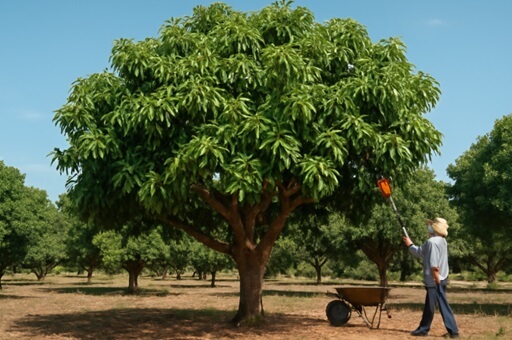
Commercial mango lumber can make productive use of orchard trees that are removed or replaced after fruit production declines. Suitable trunks can then be sawn into lumber instead of being discarded.
For U.S. buyers, mango is usually a specialty imported hardwood rather than a standard domestic lumber species. Suppliers may offer boards, slabs, turning stock, craft blanks, veneer, plywood, and figured or spalted material, including lumber from Hawaii and Asian sources.
Mango Wood Quick Facts
| Property | Typical value or description |
|---|---|
| Scientific name | Mangifera indica |
| Wood type | Tropical hardwood |
| Average dried weight | 42.1 lb/ft³ (675 kg/m³) |
| Janka hardness | 1,070 lbf (about 4,780 N) |
| Bending strength (MOR) | About 12,830 psi (88.5 MPa) |
| Grain and texture | Straight to interlocked grain; medium to coarse texture |
| Typical color | Golden brown, often with yellow, pink, black, gray, or other contrasting streaks |
| Natural rot resistance | Moderately durable to perishable; susceptible to fungal and insect attack |
| Shrinkage | Radial 3.6%; tangential 5.5%; volumetric 8.9%; T/R ratio 1.5 |
| Common uses | Furniture, veneer, plywood, turned objects, flooring, instrument parts, and decorative work |
| Conservation/trade status | IUCN Data Deficient; not currently listed in the CITES Appendices |
Mango Wood Color, Grain and Appearance
Mango is visually less uniform than many familiar furniture woods. Its natural color, grain direction, figure, and frequent spalting can make two boards from the same species look noticeably different.
Natural Color and Grain
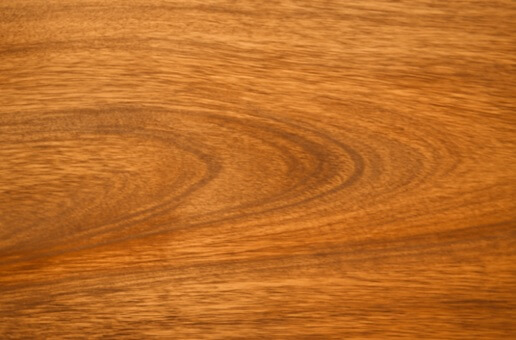
Mango heartwood is typically golden brown, but yellow, pink, black, gray, and other contrasting streaks can occur. Curly, mottled, and strongly figured grain is also common. This natural variation is a major part of the wood's appeal, but it also means buyers should not expect every table, cabinet, or board to match perfectly. If figure is the main reason for choosing a wood, Curly Maple offers another useful comparison because its value is strongly tied to its distinctive rippled figure.
The grain can be straight or interlocked, and the wood has a medium-to-coarse texture. A finished tabletop may feel completely smooth after machining, sanding, and coating, but that smooth surface should not be confused with the wood's natural texture.
Raw mango wood often looks lighter and less saturated than the same board after finishing. Clear oils and other coatings can deepen the golden-brown tones and increase contrast. “Raw” in this context means unfinished; it does not necessarily mean green, wet, or freshly cut lumber.
What Is Spalted Mango Wood?
Spalted mango is wood whose appearance has been altered by fungal activity, often producing dark zone lines, contrasting patches, and unusually dramatic figure. Spalting can make mango especially decorative and is one reason some boards show far more color variation than normal golden-brown heartwood.
The visual effect does not automatically mean the wood is unusable, but heavily decayed areas can lose strength. For furniture or turning stock, the important distinction is whether the spalting is primarily decorative or has progressed far enough to leave the material soft or structurally compromised.
Mango Wood Properties
Mango combines moderate hardness and weight with relatively modest shrinkage and workable machining characteristics. These properties help explain why it performs well in indoor furniture without behaving like an especially hard or weather-resistant tropical species.
Janka Hardness
Mango has a Janka hardness of about 1,070 lbf. That is sufficient for tables, cabinets, shelving, bed frames, case furniture, and many other household applications, but it is lower than red oak at about 1,220 lbf and white oak at about 1,350 lbf.
Janka hardness measures resistance to indentation rather than every form of mechanical strength. In practical terms, mango can handle normal furniture use but may dent or scratch more readily than harder species when subjected to the same impact or abrasion.
Density and Strength
Mango averages about 42.1 lb/ft³ (675 kg/m³) at 12% moisture content. That puts it close to red oak in weight and gives furniture a substantial feel without making mango an unusually heavy hardwood.
Typical modulus of rupture is about 12,830 psi. For buyers, the more useful interpretation is that properly dried, well-constructed mango has adequate strength for ordinary tables, cabinets, chairs, beds, shelving, and similar indoor furniture components.
Shrinkage and Stability
Reported shrinkage is about 3.6% radial, 5.5% tangential, and 8.9% volumetric, with a T/R ratio around 1.5. These figures suggest relatively moderate and balanced movement, but mango is still solid wood and continues to respond to changes in moisture.
Proper drying and acclimation remain important before final machining and assembly. Poorly dried stock can move after construction even when the species itself has reasonably favorable shrinkage characteristics.
Workability and Finishing
Mango can machine well, especially when the grain is straight, but interlocked or wild grain may tear out during planing or routing. Reaction wood can also shift as it is sawn and may bind against a blade.
The species has relatively high silica content and can dull cutting edges faster than expected, so sharp carbide tooling is useful for repeated machining. Mango generally glues and finishes well. On figured or spalted stock, test the finish on an offcut because clear coatings can noticeably change color and contrast.
Mango has also been reported to cause skin irritation in some people. Good dust extraction, eye protection, and appropriate respiratory protection are sensible precautions when cutting or sanding it.
Is Mango Wood Durable?
Mango can be durable in everyday furniture without being naturally durable in every environment. Separating wear resistance from moisture and decay resistance makes it easier to understand where the wood performs well and where it needs more protection.
Indoor Furniture Durability
For normal indoor furniture, mango is durable enough for regular household use. Its 1,070-lbf Janka hardness provides reasonable resistance to dents, and properly dried stock has suitable strength and dimensional behavior for tables, cabinets, dressers, beds, bookcases, and similar pieces.
It is not exceptionally hard, however. Dining and coffee tables can still develop scratches, dents, or finish damage from dragged objects, heavy impacts, hot cookware, or repeated abrasion. Coasters, placemats, felt pads, and normal household care can substantially reduce this type of wear.
Water and Moisture Resistance
Mango wood is not waterproof. A suitable finish can slow moisture exchange and protect a tabletop from routine spills, but it does not turn the wood into a naturally weather-resistant species.
Untreated mango is rated from moderately durable to perishable in natural rot resistance and can be susceptible to fungal and insect attack. The practical concern is greatest when unfinished or poorly protected wood experiences repeated wetting, standing water, persistent dampness, or prolonged exterior exposure.
Can Mango Wood Be Used Outdoors?
Mango can be used in protected situations, but it is not one of the better natural choices for permanently exposed outdoor furniture or structures. Keeping it under cover and maintaining an exterior-grade finish can improve protection, but the underlying wood still lacks the natural weather resistance of more established exterior species.
For outdoor furniture, Teak wood has much stronger natural weather resistance. For decking and other severe exterior exposure, Ipe wood is a more established option.
Is Mango Wood Good for Furniture?
Mango is best suited to indoor furniture where natural variation, moderate hardness, and distinctive grain are advantages rather than drawbacks. Construction quality and proper drying matter just as much as the species name on the product label.
Best Uses for Mango Wood
Mango is commonly used for dining tables, coffee tables, dressers, cabinets, sideboards, consoles, bookcases, bed frames, benches, shelving, and decorative pieces. Other uses include veneer, plywood, turned objects, flooring, decorative panels, and selected musical-instrument parts.
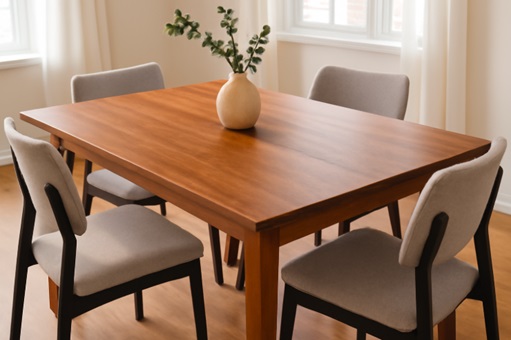
It is a good material for a dining table when normal indoor use is expected. The wood is hard enough for everyday meals and general household activity, while its varied grain can make a large tabletop visually distinctive. It still benefits from coasters, placemats, trivets, and prompt spill cleanup. White oak and some other species offer greater dent resistance or better natural performance in moisture-prone conditions.
Solid Mango Wood vs. Veneer and Engineered Wood
Furniture described as solid mango wood should use mango lumber for the components identified as solid wood. That is different from mango veneer, where a thin layer of real mango is applied over another core material, or from manufactured panels that simply use a mango-colored finish.
Veneer and plywood are legitimate furniture materials and can be appropriate for large panels or stable constructions; the issue is accurate labeling rather than one construction automatically being inferior. Buyers should check the product specification instead of assuming that every item marketed as “mango furniture” is made entirely from solid mango lumber.
What to Check Before Buying Mango Wood Furniture
The quality of mango furniture depends on drying, joinery, machining, and finishing as well as the wood species itself. A well-made piece should feel stable, have properly fitted joints, and show no obvious signs of active movement such as severe warping or fresh cracks.
- Check whether the main components are solid mango, veneer, plywood, or another engineered material.
- Ask whether the lumber was properly kiln-dried before construction.
- Look for stable joints, flat panels, and doors or drawers that operate correctly.
- Inspect large tops for excessive cracks, cupping, or twisting.
- Check whether exposed surfaces, edges, and vulnerable areas are properly finished.
- Ask what type of finish was used so future cleaning and maintenance match the coating.
Mango Wood Pros and Cons
Mango has several qualities that make it attractive for indoor furniture, but those strengths come with practical limits. Comparing the advantages and disadvantages side by side helps show whether it fits a particular project or purchase. If you are still comparing materials, our wood guide explains the main properties to consider when choosing wood.
| Pros | Cons |
|---|---|
| Distinctive golden-brown color, figure, and natural streaking | Natural variation may not suit buyers who want perfectly matched pieces |
| 1,070-lbf Janka hardness is adequate for normal indoor furniture | Lower dent resistance than red oak and white oak |
| Relatively moderate shrinkage and balanced dimensional movement | Still requires proper drying and acclimation |
| Glues and finishes well | Interlocked grain can tear out; silica can dull cutting edges |
| Can make productive use of trees removed from fruit orchards | Sustainability depends on sourcing, processing, transport, and traceability |
| Available as boards, slabs, veneer, plywood, and figured specialty stock | Limited natural resistance to prolonged moisture, fungi, and insects |
Mango Wood vs. Oak
Comparing mango with “oak” is most useful when red oak and white oak are treated separately. Both are common U.S. hardwoods, but they differ from mango—and from each other—in hardness, appearance, availability, and natural durability.
Mango Wood vs. Red Oak
Mango is slightly softer and lighter than red oak. Its Janka hardness is about 1,070 lbf compared with roughly 1,220 lbf for red oak, while average dried weight is about 42.1 lb/ft³ for mango and 43.8 lb/ft³ for red oak.
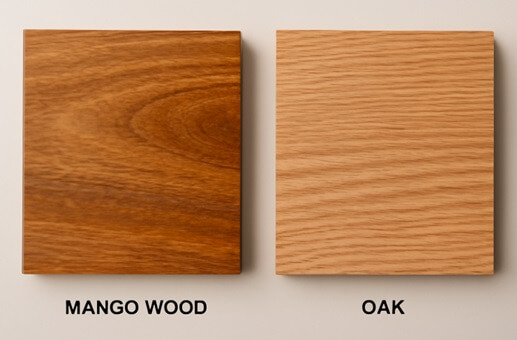
The visual difference is often more noticeable than the weight difference. Red oak usually has a light-to-medium brown color with a reddish cast and a more familiar open oak grain, while mango can show golden brown, dark streaks, figured grain, and substantial board-to-board variation. Red oak is also much more widely available as domestic lumber in the United States.
Mango Wood vs. White Oak
White oak is harder and heavier than mango, with a Janka hardness around 1,350 lbf and average dried weight around 47 lb/ft³. It therefore provides greater resistance to indentation under comparable use.
The more important difference for moisture-prone applications is natural durability. White oak is rated very durable against decay, while mango ranges from moderately durable to perishable. That makes white oak the stronger candidate when moisture exposure or natural decay resistance is an important part of the decision.
Which Is Better for Furniture?
There is no universal winner. Mango is a good choice when distinctive color variation and figured grain are priorities in indoor furniture. Red oak is easier to source domestically and offers somewhat greater dent resistance, while white oak combines higher hardness with much better natural decay resistance.
For an indoor dining table, cabinet, dresser, or decorative piece, any of the three can work well when properly constructed. The better choice depends on appearance, budget, sourcing, expected wear, and whether moisture resistance is important.
| Property | Mango | Red Oak | White Oak |
|---|---|---|---|
| Janka hardness | 1,070 lbf | 1,220 lbf | 1,350 lbf |
| Average dried weight | 42.1 lb/ft³ | 43.8 lb/ft³ | 47.0 lb/ft³ |
| Typical color | Golden brown with variable contrasting streaks | Light to medium brown, commonly with a reddish cast | Light to medium brown, often with a more olive cast |
| Grain/texture | Straight to interlocked; medium to coarse | Straight; coarse and open | Straight; coarse with prominent rays |
| Natural rot resistance | Moderately durable to perishable | Non-durable to perishable | Very durable |
| U.S. availability | Specialty imported lumber and finished furniture | Widely available domestic hardwood | Widely available domestic hardwood |
| Best fit | Distinctive indoor furniture and decorative work | Furniture, cabinets, flooring, and interior trim | Heavy-use furniture, flooring, and applications needing better moisture/decay resistance |
Mango Wood Price and Availability in the U.S.
Mango is available in the United States, but it occupies a different market position from domestic woods such as oak. Price depends heavily on whether the buyer needs ordinary lumber, figured specialty stock, slabs, veneer, or finished furniture.
In the U.S. lumber market, mango is better described as a moderately priced imported specialty wood than as a cheap domestic hardwood. Unfigured boards are generally available from specialty suppliers in a moderate price range for imported lumber, while curly, quilted, vividly colored, or spalted material can cost substantially more.
Availability also depends on the form required. Mango is sold as boards and slabs as well as turning blanks, craft stock, veneer, plywood, and instrument blanks. Hawaii is an important source of specialty and figured mango in the U.S. market, while Asian material is also common.
Finished furniture pricing should not be confused with raw-lumber pricing. An imported mango table can sometimes retail for less than a comparable premium oak or tropical-hardwood piece because manufacturing location, construction, freight, brand, and finish all affect the final cost. For that reason, “mango is cheaper than oak” is not a reliable rule for every purchase.
Is Mango Wood Sustainable?
Mango can offer a useful sustainability advantage when timber becomes a second commercial use for trees originally grown for fruit. That benefit is real, but it does not mean every mango product automatically has the same environmental profile.
Mango Wood as an Orchard By-Product
Mango lumber can make productive use of orchard trees that are removed or replaced after fruit production declines. Instead of treating the trunk only as waste, suitable logs can be converted into furniture, veneer, turning stock, and other wood products. For another decorative species often considered alongside mango among alternative wood options, see Olive Wood.
This secondary use is one reason mango is often presented as an environmentally attractive furniture material: the tree may have already provided years of agricultural value before its wood enters the timber supply.
What Responsible Sourcing Still Requires
The orchard-by-product story should not be treated as proof that every mango product is automatically sustainable. Environmental performance still depends on traceability, land and orchard management, processing and drying practices, transport distance, manufacturing quality, and how long the finished product remains useful.
Mangifera indica is currently reported as Data Deficient by the IUCN, in part because widespread cultivation and naturalization make the status of genuinely wild populations difficult to assess. The species is not currently listed in the CITES Appendices.
For U.S. buyers, the strongest claim is therefore a specific one: mango can provide a second commercial use for retired orchard trees, while the environmental quality of any particular product still depends on the supply chain behind it.
How to Care for Mango Wood Furniture
Mango furniture does not require unusual maintenance, but protecting it from prolonged moisture, heat, and unnecessary abrasion helps preserve both the wood and its finish. The correct care routine also depends on the coating already on the piece.
Cleaning and Spill Protection
Dust with a soft cloth and wipe spills promptly. For routine cleaning, a lightly damp cloth is usually preferable to soaking the surface or using aggressive cleaners. Do not leave standing water on tabletops, shelves, cabinet tops, or unfinished edges.
Use coasters, placemats, felt pads, or similar protection where frequent contact may scratch the finish or dent the wood. These simple precautions are especially useful on dining tables, coffee tables, and desks.
Heat, Sunlight and Humidity
Use trivets or other heat protection under hot cookware rather than placing it directly on a finished surface. Furniture should also be kept away from persistent dampness and large, repeated swings in humidity that can encourage seasonal movement.
Strong direct sunlight can also alter the appearance of many wood finishes over time. When practical, avoid placing a piece where only one section receives intense sunlight for long periods while the rest remains continuously shaded.
Oil, Wax and Existing Finishes
Do not assume that every mango table should be periodically oiled. A piece may already have an oil, wax, lacquer, polyurethane, or another film finish, and maintenance products that work well with one coating may be unnecessary or inappropriate for another.
When the finish is known, follow the furniture maker's care instructions or use products compatible with that coating. If the finish is unknown, gentle cleaning is safer than automatically applying oil or wax.
Frequently Asked Questions About Mango Wood
These answers cover several common buying and ownership questions that do not require a full section of their own. They also clarify practical limits that can be easy to miss when mango is described simply as a hardwood.
Is Mango Wood Expensive?
Mango is generally a moderately priced imported specialty wood rather than one of the most expensive tropical hardwoods. Ordinary unfigured stock can be reasonably priced, while wide slabs, strong curl, vivid coloration, or attractive spalting can command a premium.
Does Mango Wood Scratch Easily?
Mango is hard enough for everyday furniture, but its 1,070-lbf Janka rating is lower than red or white oak. It can therefore develop dents and scratches under rough use, especially on tabletops.
Is Mango Wood Waterproof?
No. A suitable finish can protect mango from normal spills and slow moisture absorption, but the wood itself is not waterproof. Standing water or persistent dampness can cause movement, staining, finish failure, and biological deterioration.
Does Mango Wood Attract Bugs?
Properly dried and finished indoor mango furniture should not be assumed to have an insect problem. Untreated wood can be susceptible to insect attack, particularly when storage, moisture, or environmental conditions favor infestation.
How Long Does Mango Wood Furniture Last?
There is no fixed lifespan for mango furniture. A well-dried, well-constructed piece used indoors and protected from prolonged moisture can remain serviceable for many years. Joinery, finish quality, environment, maintenance, and intensity of use are at least as important as the species itself.
Explore More About Wood: