Basswood: Properties, Uses & Working Characteristics
Basswood is the lumber of American basswood (Tilia americana), a North American hardwood known for being unusually light, soft, fine-textured, and easy to work. Although it is botanically a hardwood, its Janka hardness is only about 410 lbf, which helps explain why it is one of the most widely used woods for carving and other detailed hand-tool work.
Basswood is also used for models, crafts, musical instruments, veneer, shutters, and lightweight interior components. Its softness makes cutting and shaping easy, but it also means the wood dents readily and is poorly suited to heavy wear or prolonged outdoor exposure. This guide covers its appearance, physical properties, workability, finishing, uses, durability, comparisons, and what to check when buying basswood lumber.
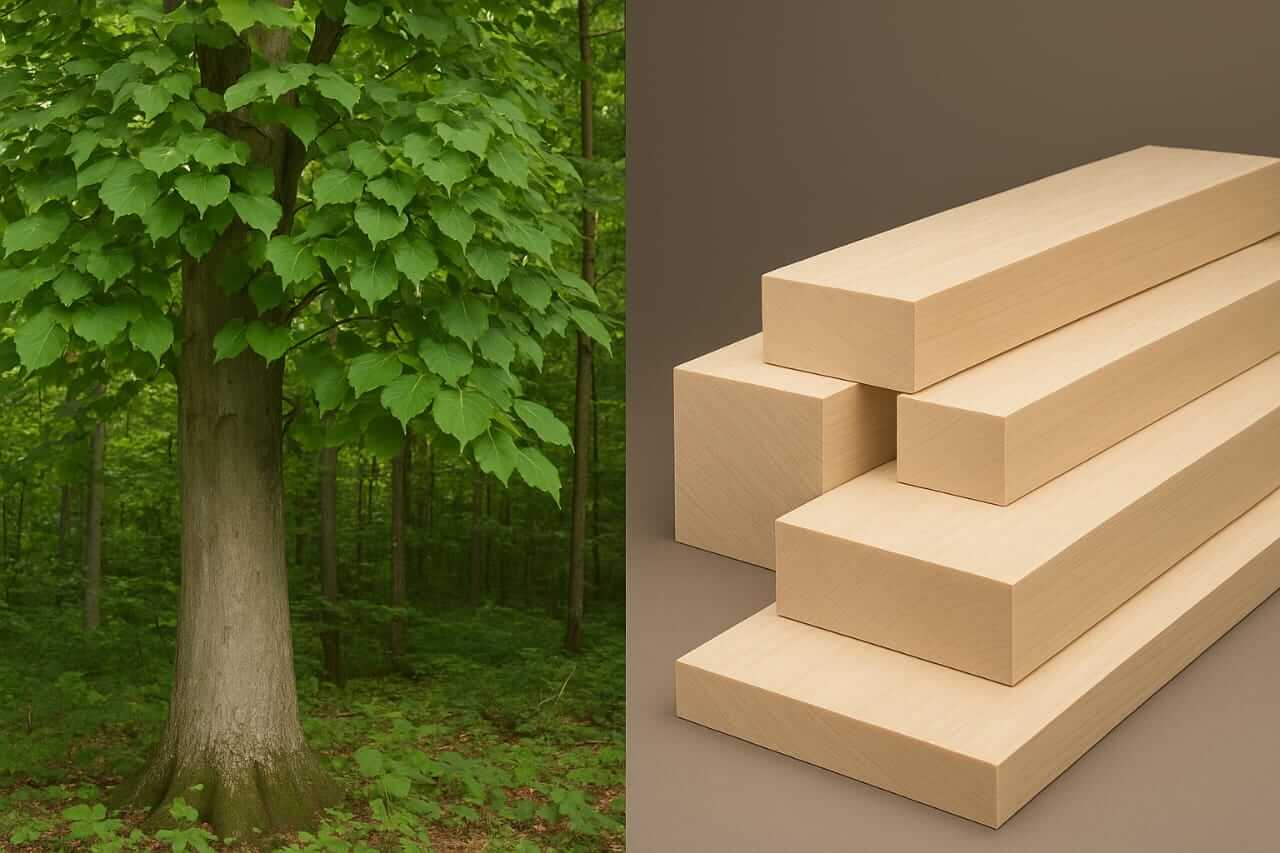
What Is Basswood?
Basswood is best understood as a lightweight North American hardwood whose botanical classification can be misleading if hardness is judged by the word “hardwood” alone. Its species identity and common names also vary somewhat between North American and European usage.
Is Basswood a Hardwood or Softwood?
Basswood is a hardwood because it comes from a flowering broadleaf tree rather than a conifer. Hardwood and softwood are botanical classifications; they do not directly describe how hard a piece of lumber feels or how resistant it is to denting.
Mechanically, basswood is very soft for a hardwood. Its low density and Janka hardness make it much easier to cut and carve than denser species such as hard maple or oak. This combination—hardwood classification with relatively soft wood—is one of the most important things to understand about basswood.
American Basswood, Linden and Limewood
In the United States, American basswood generally refers to Tilia americana. The genus Tilia also contains other species commonly called linden, especially in North America, or lime and limewood in Europe.
These common names are related but should not be treated as guarantees that the wood comes from the same species. European limewood, for example, may come from European Tilia species rather than Tilia americana. When species-specific properties matter, the botanical name is more reliable than the common name alone.
Basswood Quick Facts
| Property | Typical value or description |
|---|---|
| Scientific name | Tilia americana |
| Wood type | Hardwood |
| Janka hardness | About 410 lbf |
| Average dried weight | About 26 lb/ft³ (415 kg/m³) |
| Modulus of rupture | About 8,700 psi (60 MPa) |
| Modulus of elasticity | About 1.46 million psi (10.1 GPa) |
| Grain | Usually straight with a fine, even texture |
| Color | Pale white to light brown, with limited sapwood/heartwood contrast |
| Natural decay resistance | Poor; primarily suited to indoor use |
| Best known for | Carving and easy workability |
Basswood Color, Grain and Appearance
Basswood has a subtle, uniform appearance rather than the bold figure found in many decorative hardwoods. Its pale color and fine texture are especially useful when the goal is precise carving, painting, or a visually unobtrusive wood surface.
Color and Sapwood/Heartwood
American basswood is typically pale white, creamy, or light brown. The sapwood is broad and usually very light, while the heartwood may be slightly darker, sometimes showing pale brown or reddish-brown tones.
The difference between sapwood and heartwood is often less dramatic than in species such as walnut or oak. This relatively uniform color is useful for carved pieces, painted projects, models, and applications where a consistent background is more important than dramatic natural figure.
Grain and Texture
Basswood grain is generally straight and visually subtle. The wood has a fine, even texture, which is one of the main reasons it responds so well to knives, chisels, gouges, sanding, and painted finishes.
Because there is relatively little prominent figure to distract from the shape of a piece, basswood is especially useful when the design comes from carving or form rather than from the grain pattern itself.
Basswood Properties
Basswood combines low weight and low hardness with enough strength for many light-duty interior applications. Looking at hardness, density, strength, and dimensional movement separately gives a more accurate picture than simply describing the wood as either “soft” or “strong.”
Janka Hardness
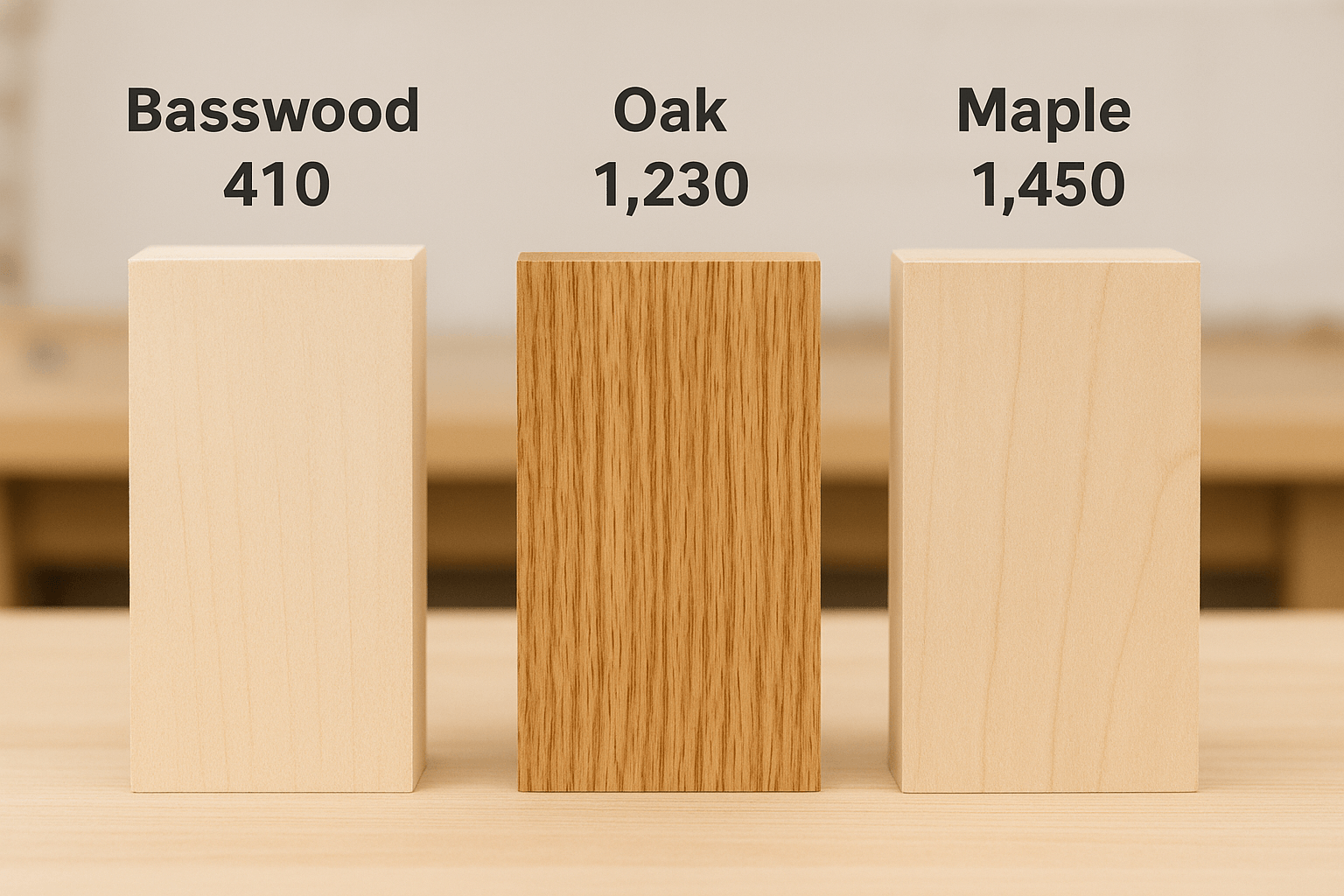
American basswood has a Janka hardness of about 410 lbf. The Janka test measures resistance to indentation, so this number primarily tells us that basswood dents and scratches more easily than harder woods.
The low Janka rating is a disadvantage for floors and high-impact surfaces but a major advantage for carving. Hand tools can remove material with relatively little effort, and detailed shapes can be developed without fighting a dense, highly resistant wood.
Density and Weight
Basswood has an average dried weight of about 26 lb/ft³ (415 kg/m³), making it one of the lighter North American hardwoods commonly encountered in woodworking.
Its low weight makes larger carved pieces easier to handle and is also useful in models, shutters, crafts, and musical instrument components where unnecessary mass can be a disadvantage.
Strength and Stiffness
Basswood's modulus of rupture is about 8,700 psi, while its modulus of elasticity is about 1.46 million psi. These values describe bending strength and stiffness rather than resistance to surface dents.
The distinction matters because Janka hardness alone does not tell you whether a piece of wood will bend, flex, or fail under load. Basswood provides adequate performance for many carvings, models, shutters, interior components, and hobby projects, but it is not normally selected for demanding structural applications.
Shrinkage and Dimensional Stability
Typical shrinkage values for American basswood are about 6.6% radial, 9.3% tangential, and 15.8% volumetric, with a tangential-to-radial ratio of roughly 1.4.
As with other hardwoods, properly dried lumber should be allowed to acclimate before final machining and assembly. Wide boards and precision projects should still be designed to accommodate normal seasonal wood movement.
Working With Basswood
Easy workability is the characteristic most strongly associated with basswood. Its softness and fine texture make it especially easy to work with hand tools and generally cooperative in machining when sharp cutters are used, although clean results still depend on careful handling.
Carving and Hand Tools
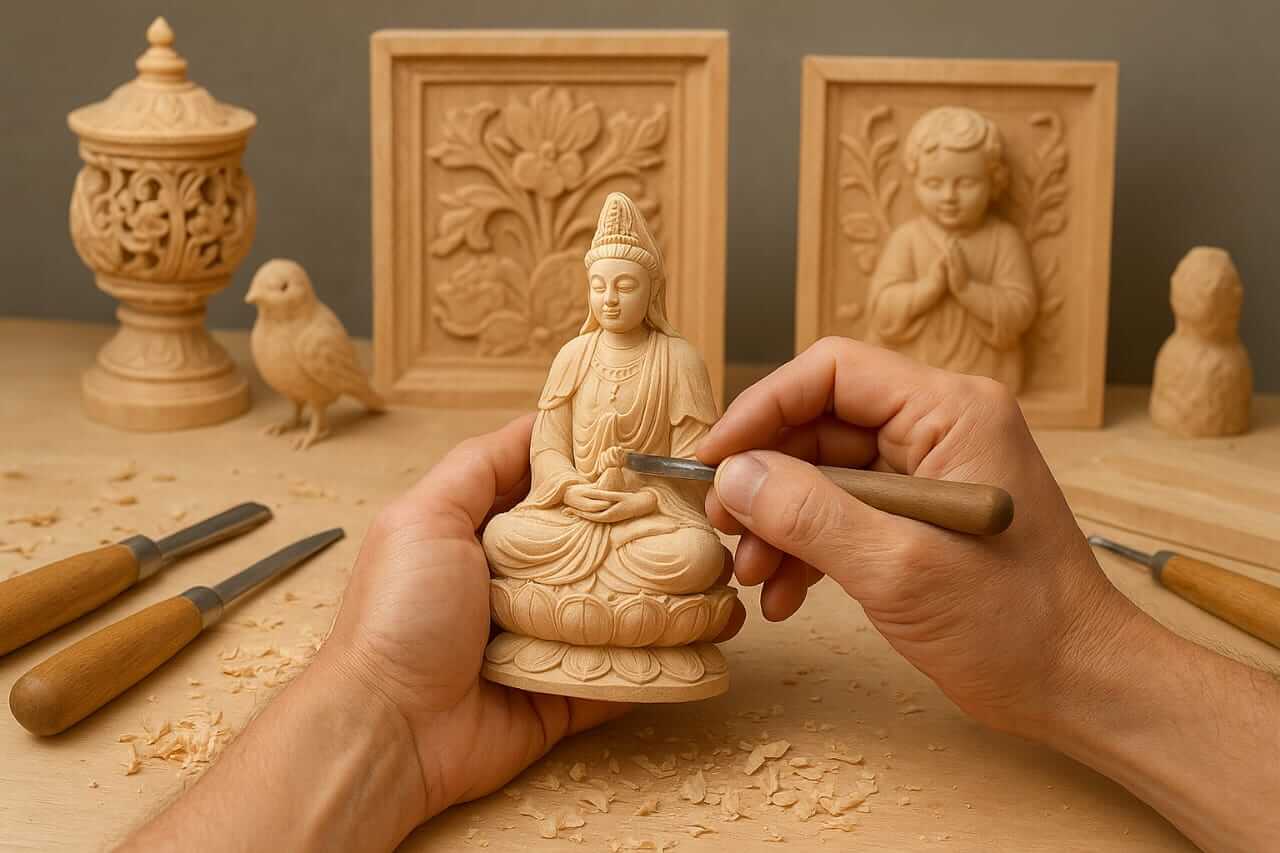
Basswood is one of the standard woods for carving and whittling because knives, chisels, and gouges can cut it with relatively little resistance. Its fine, uniform texture allows small details to be formed without the pronounced grain changes that can make some hardwoods unpredictable.
This makes basswood particularly approachable for beginners, but it is equally useful for experienced carvers producing figurines, relief work, ornaments, architectural details, and other intricate pieces.
Machining and Sanding
Basswood generally machines and sands easily, but its soft fibers require sharp tools for the cleanest surface. Dull cutters or overly aggressive sanding can crush or lift fibers instead of cutting them cleanly.
Light cuts and appropriately sharp blades, router bits, knives, and chisels are particularly useful when fine surface quality matters. Sanding should be controlled rather than aggressive because the wood can be removed quickly.
Gluing, Nailing and Screwing
Basswood generally glues well and is easy to assemble in light-duty woodworking. Its softness, however, means fasteners can compress the surrounding fibers more easily than they would in harder hardwoods.
Basswood has relatively poor nail-holding ability, and its softness means fasteners should not substitute for properly designed joinery in demanding joints.
Preventing Fuzzy Grain and Dents
Soft basswood fibers can sometimes produce a fuzzy surface when cut with dull tools. Sharp edges and clean slicing cuts help prevent this problem, particularly in fine carving and across delicate details.
The wood also dents easily. Pieces should be protected from hard bench surfaces, dropped tools, clamps applied with excessive pressure, and other impacts that can permanently compress the surface before finishing.
How to Finish Basswood
Basswood can be finished in several ways depending on whether the goal is to preserve its pale natural appearance, create a smooth painted surface, or introduce additional color. Its subtle grain makes surface preparation especially important because the finish often becomes a major part of the final appearance.
Clear Finishes
Clear finishes can preserve basswood's understated natural look while providing protection from handling, dirt, and minor abrasion. Water-clear coatings generally retain a paler appearance, while more ambering finishes can warm the wood toward yellow or gold.
Because basswood does not usually have dramatic figure to emphasize, the main goal of a clear finish is often protection and an even surface rather than creating strong grain contrast.
Painting Basswood
Basswood is well suited to painted projects because its grain is fine and visually subtle. Proper sanding and priming can create a smooth surface for carvings, models, toys, decorative pieces, and other work where color rather than natural grain is intended to dominate.
Staining and Blotch Control
Staining basswood requires more care because color can absorb unevenly and produce a blotchy appearance. When a uniform stained surface is important, test the complete finishing schedule on scrap before treating the finished project.
A washcoat, sealer, toner, dye, or other controlled coloring method may produce a more predictable result than applying a heavy penetrating stain directly to raw basswood. The best approach depends on the desired color and finish system.
What Is Basswood Used For?
Basswood performs best in projects that benefit from low weight, easy cutting, and a fine uniform texture. Its most successful applications generally place workability and detail ahead of maximum hardness or weather resistance.
Carving and Whittling
Carving is probably the use most strongly associated with basswood. The wood is widely used for figurines, relief carving, ornaments, decorative panels, whittling, practice blocks, and detailed sculptural work.
Its combination of low cutting resistance and fine texture makes it useful for beginners while still allowing skilled carvers to produce intricate detail.
Models, Patterns and Crafts
Basswood strips, sheets, blocks, and boards are commonly used for architectural models, miniature structures, prototypes, educational projects, crafts, toys, and patterns. The wood is easy to cut accurately and glues well, which is especially useful for lightweight assemblies.
Musical Instruments
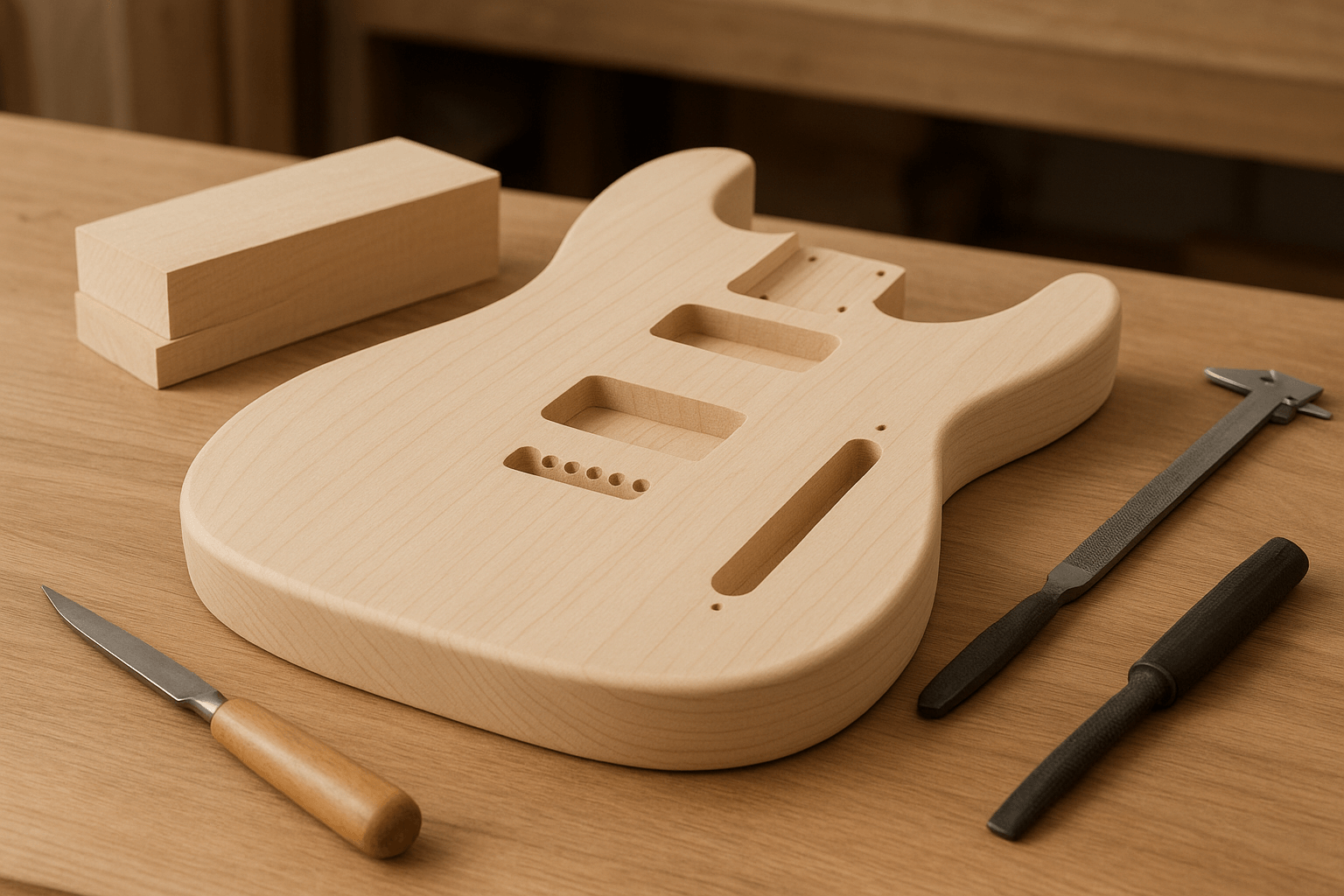
Basswood is commonly used for electric guitar bodies and some other instrument components because it is lightweight, relatively consistent, and easy to machine. Its low weight can be particularly useful where the finished instrument must remain comfortable to handle.
Claims that basswood automatically produces a particular “balanced” or superior tone should be treated cautiously. The sound of an instrument depends on its complete design, construction, hardware, electronics, and other materials rather than on a single broad description of the wood.
Shutters, Veneer and Interior Woodwork
Basswood is also used for shutters, blinds, veneer, lightweight interior millwork, mouldings, drawer components, and other indoor applications where its low weight and easy machining are useful.
For furniture, basswood is more appropriate for protected or lightly loaded components than for exposed surfaces expected to resist years of impacts and abrasion.
When Should You Avoid Basswood?
The same softness that makes basswood easy to carve also creates clear limitations. It is usually a poor choice when a project requires strong resistance to dents, heavy structural loads, prolonged moisture, or demanding exterior exposure.
Flooring and High-Wear Surfaces
At about 410 lbf on the Janka scale, basswood dents too easily to be an ideal flooring material or a first choice for heavily used tabletops, work surfaces, benches, and other areas exposed to repeated impact.
Structural and Heavy-Duty Projects
Basswood can perform well in many lightweight assemblies, but it is not generally selected for major structural framing, load-bearing exterior construction, impact-resistant handles, or other jobs where strength and stiffness are the primary requirements.
Outdoor and Wet Environments
Basswood has poor natural resistance to decay and is primarily an indoor wood. A surface coating may slow moisture entry, but it does not turn basswood into a naturally durable exterior species.
| Good Uses for Basswood | Usually Avoid Basswood For |
|---|---|
| Carving and whittling | Heavy-traffic flooring |
| Models and crafts | High-impact work surfaces |
| Painted projects | Heavy structural construction |
| Instrument components | Unprotected exterior exposure |
| Shutters and lightweight interior parts | Persistently wet environments |
Is Basswood Durable?
Durability depends on what type of damage is being considered. Basswood can remain serviceable for many years in appropriate indoor applications, but it has relatively low resistance to surface wear and little natural protection against decay in damp environments.
Dent and Wear Resistance
Basswood's low Janka hardness means it dents more readily than oak, maple, and many other common hardwoods, so exposed surfaces require more careful handling.
Rot and Decay Resistance
American basswood is non-durable in regard to heartwood decay. Repeated moisture exposure therefore makes it a poor choice when natural rot resistance is required.
Indoor vs. Outdoor Use
Basswood is best kept indoors; exterior projects are generally better served by species with greater natural decay resistance.
How to Buy Basswood
Choosing basswood lumber is less about finding dramatic grain and more about selecting clean, stable material suited to the project. Carvers, model makers, and general woodworkers may need different dimensions, but all benefit from checking the stock carefully before purchase.
What to Look for in Basswood Lumber
For general woodworking and carving, look for straight, relatively clear lumber with uniform texture and as few knots or defects as the project requires. Pale, consistent stock is often desirable for carving and painted work, although color variation alone is not necessarily a defect.
Carving Blocks vs. Boards
Basswood is sold as conventional boards as well as carving blocks, blanks, thin strips, sheets, and hobby stock. A carver may value thick, clear blocks, while a model builder may need thin dimensionally consistent strips and sheets.
Buying the form closest to the final project can reduce waste and minimize unnecessary milling, especially when only small components are required.
Moisture, Dents and Defects
Check that lumber has been properly dried for indoor woodworking and inspect it for bow, cup, twist, end checks, deep compression dents, knots, staining, insect damage, or other defects that reduce the usable area.
Because basswood is soft, handling damage that would be minor on a harder species can leave permanent depressions. Inspect faces and edges carefully when a clean carved or painted surface is important.
Basswood Buying Checklist
- Species: Confirm American basswood when species-specific properties matter.
- Stock type: Choose boards, carving blocks, blanks, strips, or sheets to match the project.
- Texture: Look for fine, even stock suitable for clean cutting.
- Knots: Minimize knots when carving or machining detailed pieces.
- Moisture: Use properly dried lumber for indoor projects.
- Flatness: Check for bow, cup, and twist.
- Surface damage: Inspect for compression dents and handling marks.
- Checks and splits: Confirm that defects do not reduce the required usable dimensions.
- Insect damage: Avoid visibly compromised stock.
- Dimensions: Choose enough thickness and width for final shaping and machining.
Basswood vs. Similar Woods
Basswood is often compared with other familiar woods because its softness and low weight make it behave very differently from conventional furniture hardwoods. The most useful comparison depends on whether the project prioritizes carving, strength, wear resistance, or lightweight construction.
Basswood vs. Maple
Basswood is generally lighter, softer, and easier to carve than maple. Hard maple in particular offers much greater dent and wear resistance, making it better suited to flooring, work surfaces, and furniture components exposed to frequent use.
Basswood is usually the easier choice for hand carving, models, and lightweight shaped components. Maple is preferable when greater surface durability, strength, or stiffness is required. Figured varieties such as curly maple can also offer much stronger decorative figure than basswood.
Basswood vs. Oak
Oak is considerably harder and heavier than basswood and is better suited to flooring, exposed furniture surfaces, cabinetry, and projects where resistance to dents and wear matters. Its grain is also far more pronounced.
Basswood is easier to cut and carve, weighs less, and provides a quieter grain that does not compete visually with detailed shaping or paint. For carving and light craft work, those characteristics can be more useful than oak's greater hardness.
Basswood vs. Balsa
Both basswood and balsa are lightweight woods used in models and hobby projects, but balsa is substantially lighter and softer. Basswood provides greater resistance to crushing and generally feels more substantial when a model or craft project needs additional rigidity.
Balsa is advantageous when minimum weight is the overriding priority. Basswood is often preferable when low weight still needs to be balanced with greater rigidity, cleaner edges, or strength.
Basswood vs. Poplar
Yellow poplar is heavier and somewhat harder than basswood while still being relatively easy to machine. It is commonly used for painted furniture, cabinetry, millwork, and interior components where more resistance to handling damage is desirable.
Basswood remains easier to carve and is usually more attractive for detailed hand-tool work. Poplar can be a better choice when a painted project needs greater hardness without moving to a much denser hardwood.
Frequently Asked Questions About Basswood
These questions address practical decisions that do not require another full section. They focus on beginner use, strength, furniture, exterior suitability, and the surface damage that can result from basswood's low hardness.
Is Basswood Good for Beginners?
Yes. Basswood is one of the most beginner-friendly woods for carving because it is soft, fine-textured, and relatively easy to cut with properly sharpened hand tools. It is also useful for simple models, crafts, and introductory woodworking projects.
Is Basswood Strong?
Basswood has enough strength for many light-duty indoor projects, carvings, models, shutters, and instrument components, but it is not a high-strength structural hardwood. Hardness, bending strength, and stiffness should be considered separately when evaluating it for a project.
Is Basswood Good for Furniture?
Basswood can be used for protected furniture components, carved details, mouldings, drawer parts, painted pieces, and other light-duty applications. Its low dent resistance makes it less suitable for heavily used tabletops, flooring, or exposed surfaces that regularly receive impacts.
Is Basswood Good for Outdoor Use?
Basswood is generally a poor choice for outdoor exposure because it has low natural decay resistance. Finishes can provide temporary moisture protection, but they do not give the wood the inherent durability of species naturally suited to exterior conditions.
Does Basswood Dent Easily?
Yes. Its Janka hardness of about 410 lbf means basswood can develop dents and compression marks relatively easily. That softness is beneficial for carving but requires more careful handling when the finished surface will remain exposed.
Explore More About Wood: