Wood Database: Species, Janka Hardness & Wood Properties
This wood database is a practical species finder and comparison hub for woodworkers, builders, designers, and anyone choosing wood for a specific project. Browse wood species, compare Janka hardness, review working characteristics, and find options for furniture, flooring, exterior construction, instruments, carving, and decorative work.
Each entry links to a more detailed species profile when available. Use the comparison tools below to narrow your choices by hardness, application, appearance, and workability rather than relying on a species name alone.
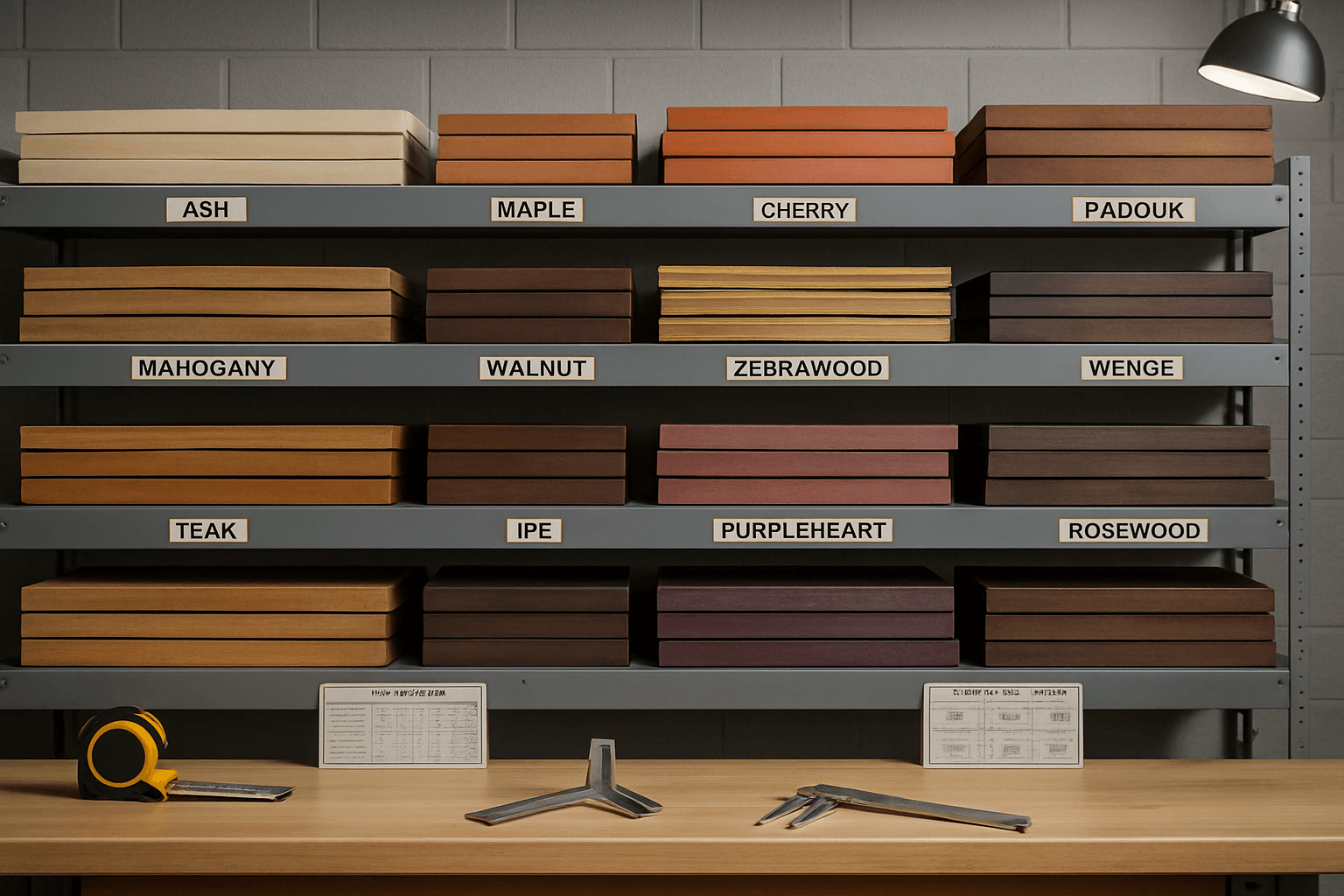
Find Wood Species
Start here if you already know the species you want to research. This alphabetical index covers hardwoods ranging from extremely dense exterior species to softer carving woods, with each profile providing technical and practical context for material selection.
- Basswood — lightweight, soft, and highly workable; a classic choice for carving and models.
- Cocobolo — dense, colorful tropical hardwood used for instruments, handles, and fine woodworking.
- Curly Maple — figured maple valued for its rippled appearance in furniture, instruments, and decorative work.
- Ipe Wood — exceptionally hard and naturally durable wood widely associated with decking and demanding exterior applications.
- Mango Wood — medium-density hardwood used for furniture and decorative work, often with distinctive color variation.
- Olive Wood — dense decorative wood with irregular grain and contrasting streaks, popular for turning and smaller specialty projects.
- Purpleheart Wood — dense tropical hardwood known for its distinctive purple heartwood and high hardness.
- Sapele — African hardwood with interlocked grain, good strength, and frequent use in furniture, millwork, and instruments.
- Teak — naturally durable hardwood widely used for outdoor furniture, boatbuilding, and marine applications.
- Wenge Wood — dark, hard African wood used in furniture, architectural millwork, veneers, and instruments.
Compare Wood Species
Technical data makes it easier to compare woods that may look similar but perform very differently. Janka hardness is useful for comparing resistance to indentation, but it should be considered alongside durability, workability, stability, and the demands of the finished project.
| Wood | Scientific Name | Representative Janka (lbf) | Workability | Common Uses |
|---|---|---|---|---|
| Ipe | Handroanthus spp. | 3,510 lbf | Difficult | Decking, exterior construction, flooring |
| Cocobolo | Dalbergia retusa | 2,960 lbf | Difficult | Instruments, handles, fine woodworking |
| Olive | Olea europaea | 2,710 lbf | Moderate to difficult | Turning, kitchenware, decorative work |
| Purpleheart | Peltogyne spp. | 2,520 lbf | Difficult | Flooring, furniture, inlays, millwork |
| Wenge | Millettia laurentii | 1,930 lbf | Moderate to difficult | Furniture, veneers, millwork, instruments |
| Curly Maple | Acer spp. | Varies by maple species | Moderate | Furniture, instruments, veneers |
| Sapele | Entandrophragma cylindricum | 1,410 lbf | Moderate | Furniture, cabinetry, millwork, instruments |
| Mango | Mangifera indica | 1,070 lbf | Moderate | Furniture, decorative objects, millwork |
| Teak | Tectona grandis | 1,070 lbf | Moderate | Outdoor furniture, decking, boatbuilding |
| Basswood | Tilia americana | 410 lbf | Easy | Carving, models, patterns, instruments |
Note: The figures above are representative reference values rather than guarantees for every board. Ipe is a commercial name applied to multiple Handroanthus species, so its hardness can vary. Curly maple describes a figure rather than a single botanical species, and its hardness depends on the underlying maple.
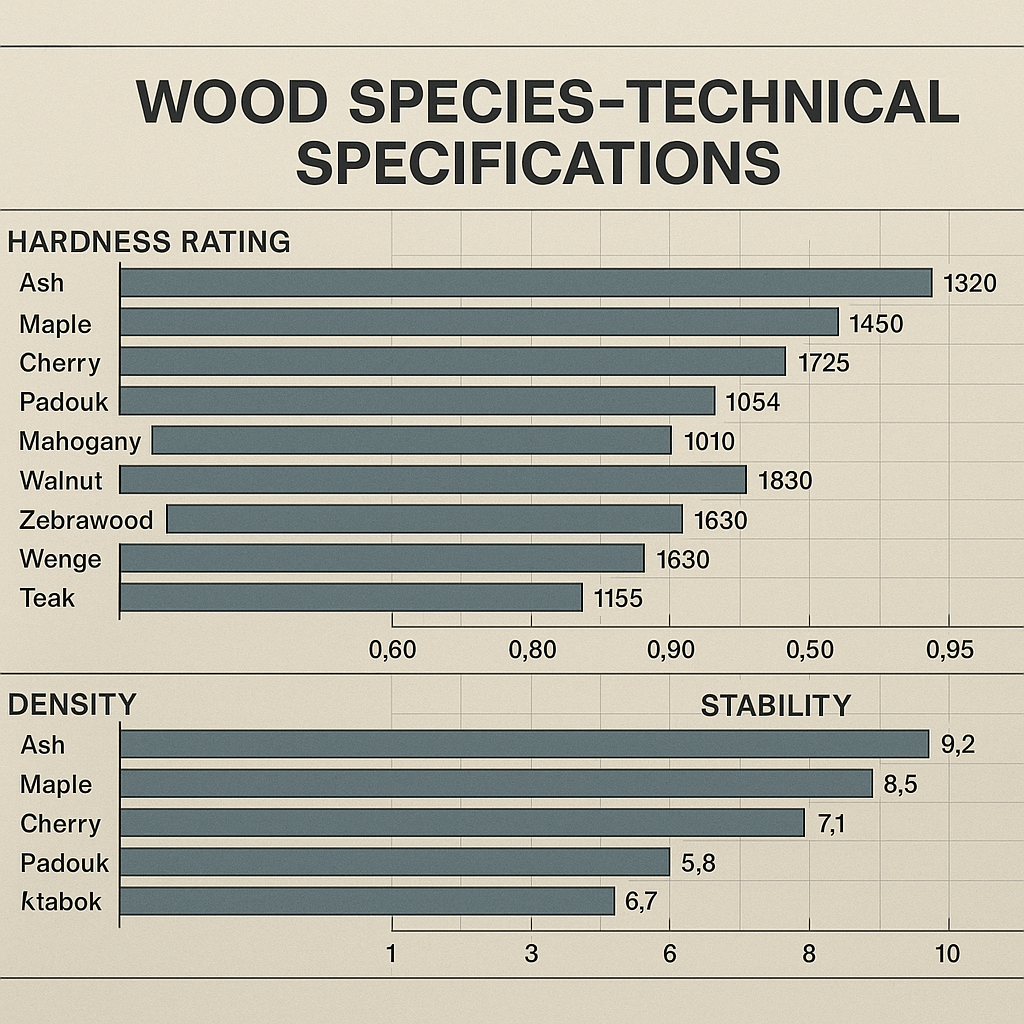
Browse the Wood Database
Species profiles provide more context than a comparison table can show. If you do not have a particular species in mind, browse the collection by visual and performance characteristics, then open an individual profile for more detailed information.
Dense and Hard Woods
Ipe, Purpleheart, and Wenge represent the harder end of the current collection. Their high density and resistance to indentation can be useful in demanding applications, but these characteristics can also increase machining difficulty and tool wear. Outdoor durability should be evaluated separately because hardness does not by itself indicate resistance to decay.
Figured and Decorative Woods
Curly Maple, Cocobolo, and Olive are especially useful when visual character is a major selection criterion. Curly maple is not a separate maple species: “curly” describes a figure that can occur in multiple Acer species, so properties such as Janka hardness depend on the underlying maple.
General-Purpose and Workable Woods
Sapele, Mango, and Basswood cover very different levels of hardness and performance. Basswood is particularly suitable when easy carving matters, while Sapele and Mango provide broader furniture and millwork possibilities.
Find Wood by Use
When the project is already defined, starting with the intended application is often faster than comparing species one by one. The groups below provide practical shortlists rather than implying that every listed wood performs identically.
- Decking and exterior projects: Ipe and Teak.
- Fine furniture and decorative millwork: Wenge, Purpleheart, Curly Maple, and Sapele.
- Musical instruments: Cocobolo, Curly Maple, Sapele, and Basswood.
- Carving and detailed handwork: Basswood.
- Turning and decorative objects: Olive, Cocobolo, and Mango.
Understanding Wood Properties
Wood selection becomes more reliable when individual measurements are interpreted correctly. Hardness, density, durability, stability, and workability describe different characteristics, so one measurement should never substitute for the complete performance profile of a species.
Janka Hardness
The Janka test measures the force required to embed a steel ball into wood to a specified depth. A higher value indicates greater resistance to indentation. This makes Janka especially useful when comparing woods for flooring and other applications where dent resistance matters, but a harder wood is not automatically stronger, more dimensionally stable, easier to work, or more durable outdoors.
Density and Weight
Density describes mass relative to volume and affects handling, machining, fastener behavior, and the finished weight of a project. Dense woods can also be exceptionally hard, but density and Janka hardness are not interchangeable measurements.
Durability
Natural durability concerns resistance to biological deterioration such as decay and insect attack. It is especially relevant for exterior and marine applications. Hardness alone does not predict decay resistance, which is why species intended for outdoor use should be evaluated separately for durability.
Dimensional Stability
Wood expands and contracts as its moisture content changes. Shrinkage data and grain orientation help indicate how a species may respond to changing humidity, while proper drying and construction methods remain essential regardless of species.
Workability
Workability includes machining, planing, sanding, gluing, turning, and finishing behavior. High density, silica, natural oils, interlocked grain, or pronounced figure can all affect shop performance even when the wood has desirable mechanical properties.
How to Use This Wood Database
The best way to use the database depends on what you already know about your project. Rather than looking for one universally “best” wood, compare the characteristics that matter for the intended application.
- Start with the application. Determine whether the project requires exterior durability, resistance to denting, easy carving, low weight, visual figure, or another specific property.
- Compare relevant properties. Use Janka hardness for indentation resistance, then consider workability, durability, stability, density, and other characteristics separately.
- Narrow the species. Use the comparison table and project categories to create a shortlist.
- Open the species profile. Review the detailed page before making a final material decision, especially when sourcing, safety, finishing, or dimensional movement matters.
About Our Wood Data
Wood properties should be treated as reference values rather than guarantees for every board. Published figures can vary because wood is a natural material and results depend on species identification, growing conditions, moisture content, specimen selection, and testing methods.
Scientific names are used wherever possible to reduce ambiguity caused by regional and commercial names. Figured terms such as curly maple are identified separately from botanical species, and technical properties are attributed to the underlying species when that distinction affects the data.
Janka hardness is reported in pounds-force (lbf) for U.S. readers. Representative values are cross-checked against established wood reference data and the detailed species profiles used throughout ExploreWood. Where a commercial name can refer to more than one species, or where a figure such as curly maple spans multiple species, the database identifies that limitation instead of presenting the number as universal.
Hardness is only one part of material selection. Detailed profiles provide additional context on density, dimensional movement, natural durability, appearance, workability, finishing, common uses, and other characteristics when reliable species-level information is available.
The database will continue to expand as additional species profiles are published. Species should be added when enough reliable information exists to create a useful profile rather than simply to enlarge the list.